TNT Bonanza: a 2026 review of cascading wins and the Bonus Buy feature
TNT Bonanza is a mining-themed slot from Booming Games built around cluster-style payouts and cascading drops. It borrows the familiar “bonanza” rhythm: wins remove symbols, new ones fall in, and a single paid spin can turn into a chain of payouts. What makes this title worth a closer look is not the theme, but the maths—how often you can expect features, how multipliers behave, and what the Bonus Buy actually buys you in practice.
Core game setup: grid, symbols, and what “cluster pays” means here
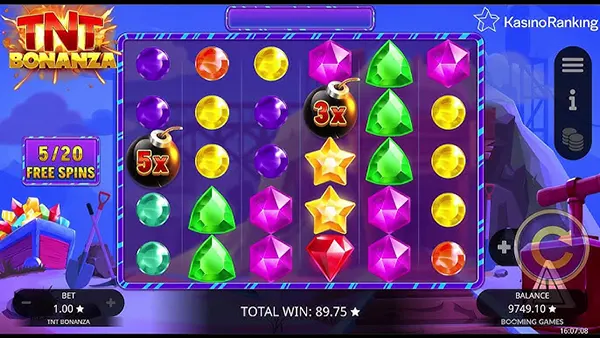
TNT Bonanza runs on a 6×5 grid with no paylines. Instead of lining symbols left to right, it pays when you land a cluster of 8 or more matching symbols anywhere on the grid. That detail changes how you read the screen: you stop hunting for “lines” and start watching for density—how easily the grid can form big groups as new symbols drop into gaps.
The bet range is typically set from 0.20 to 20.00 in the currency of the casino (for UK-facing lobbies that often means £0.20–£20.00). This range suits low-to-mid staking rather than very high limits, which matters because this is not a slot where many players want to jump straight to large spins without first seeing how the volatility feels over time.
In 2026, most published spec sheets place the RTP at 96.6% with medium-high volatility. Those numbers are only meaningful when you treat them as long-run averages: the RTP is a theoretical return over a very large sample of spins, while volatility describes the shape of the distribution—fewer small wins, with more of the value pushed into rarer feature outcomes.
Cascading wins: the mechanic that drives most of the “action”
Cascades are the engine of the base game. When a cluster pays, the winning symbols disappear, the remaining symbols drop down, and new symbols fall from the top. The cascade continues until the grid stops forming new paying clusters, so a single spin can produce several payouts, not just one.
Practically, cascades reward patience and sensible staking because “something is happening” on many spins even when the cash result is small. It’s easy to overestimate how well you’re doing if you focus on the animation rather than the balance. A good habit is to check results in stake units (for example, tracking whether a spin paid 0.2×, 1×, 5×) instead of watching only the coin counter.
Cascades also set up the bonus feature behaviour: when multipliers apply, they apply to the total win of the cascading sequence, not just a single cluster. That’s why the same multiplier value can feel dramatically different depending on whether the chain produced a modest one-step win or a longer sequence with several paying drops.
Free Spins: trigger rules, retriggers, and why the bonus is the main event
The Free Spins feature triggers when 4 or more Scatter symbols land in the base game. The default award is 10 free spins, and the bonus can be extended: landing 3 or more Scatters during the feature adds +5 extra spins. These are simple rules, but they matter because the bonus is where most high-impact outcomes are concentrated.
Feature frequency is often overlooked when players compare slots with similar visuals. Published trackers for TNT Bonanza commonly estimate the main feature triggering roughly once every couple of hundred spins (figures around the high-100s to 200s appear depending on the testing method and sample size). That should influence how you manage a session: if you are staking too high, you may run out of bankroll before you see enough bonus rounds for the volatility to “show its shape”.
It also helps to set expectations about the maximum win. A headline cap of 6,500× the stake sounds huge, but medium-high volatility means most sessions will never get close. Your realistic goal is not “hit max”, but “give yourself enough spins at a sensible stake to reach the bonus often enough for variance to settle”.
Bomb multipliers in Free Spins: how they apply and what “additive” really means
During Free Spins, special bomb symbols can land showing random multiplier values from 2× up to 100×. These multipliers are applied to the total win of the current cascading sequence, which is why longer cascade chains can matter much more in the bonus than in the base game.
If more than one bomb lands in the same sequence, the values add together to form a larger combined multiplier. “Additive” is a key word: two bombs do not multiply each other; they sum. That keeps the feature from becoming completely wild, but it still allows for sharp spikes when multiple bombs land during a productive cascade chain.
From a practical point of view, you can treat bombs as the main driver of “swingy” bonus outcomes. When Free Spins feel underwhelming, it’s often because the bonus produced short cascade chains or because bombs landed with low values at the wrong time. When the balance jumps, it’s usually the opposite: a solid chain plus a helpful summed multiplier at the end of the sequence.
Bonus Buy: what you pay for, what you get, and when it makes sense
TNT Bonanza includes a Bonus Buy option that takes you straight into Free Spins. The common published price point is 100× your current stake, and the buy guarantees a spin with 4 Scatters so the bonus starts immediately. In other words, you’re paying to skip the waiting time and move your bankroll directly into the feature’s variance.
This is where players often make a basic mistake: they treat Bonus Buy as “better value” rather than “different risk”. Buying the bonus does not magically improve the maths; it concentrates your bankroll into fewer, higher-variance events. That can be useful if you have a strict time limit for play, but it can also empty a bankroll quickly if you buy repeatedly without a plan.
A sensible way to think about it is budgeting. If your session bankroll is £100 and your stake is £0.20, a single 100× buy costs £20—one fifth of the entire session. If you push the stake to £1, the buy becomes £100, which is the whole session in one click. So the “right” stake for Bonus Buy is less about ambition and more about what you can afford to lose without chasing.
Session planning and safer play: simple guardrails that actually work
Set a clear stop-loss and a clear stop-win before you start, and treat them as non-negotiable. With medium-high volatility, it’s easy to keep playing after a bad run because you feel “due”, and it’s just as easy to give winnings back after a good bonus because the slot can cool off quickly. A pre-set boundary removes those decisions from the heat of the moment.
If you use autoplay, limit the number of spins and switch off any options that speed up play beyond what you can comfortably monitor. Faster spins mean faster variance, which can be fine if you are disciplined, but it also makes it easier to lose track of how much you’ve spent. The goal is to stay aware of the session, not to “get through” spins.
Finally, keep the basics in mind: this is entertainment, not a method of income. If gambling stops being fun, take a break. If you notice chasing behaviour, use deposit limits or cooling-off tools offered by regulated operators, and consider speaking to a support service in your country. The safest session is the one you can walk away from without feeling you need to “fix” the result.